
A home renovation loan is any credit you use to pay for repairs or improvements, and in Australia it usually takes one of four forms: a top-up on your mortgage, savings held in an offset or redraw facility, a personal loan, or a construction loan paid out in stages. The right one depends mainly on the size of the job and whether it involves structural work. The strongest position to borrow from is a fully scoped project with a written quote, because lenders lend against a defined plan and you can only size a loan once you know the real cost. That is why we at McArthur Constructions Group suggest settling the scope with your builder first and taking the figure to your lender or broker second.
TL;DR
- Cosmetic and mid-size renovations are commonly funded by a mortgage top-up, offset or redraw funds, or a personal loan. Structural projects usually suit a construction loan with progress payments.
- Lenders assess your income, expenses and existing debts. Borrowing above 80% of your property’s value may attract Lenders Mortgage Insurance.
- Compare the comparison rate, fees and total repayable, not the headline rate alone.
- Cost overruns are yours to cover, so build a contingency into the amount you borrow.
- A detailed written quote and a clear scope make every application easier.
Table of Contents
- What a home renovation loan actually is
- The four main ways to fund a renovation
- Which option fits which project
- How much you can borrow and what lenders check
- Costs and risks to check before you sign
- How to apply, step by step
- Renovating an investment property
- Our view: scope first, loan second
- Plan your renovation with McArthur
- FAQ
- Sources
What a home renovation loan actually is
There is no single product with that name. Canstar’s Australian guide describes a renovation loan as any credit product used for property repairs or improvements, with the main routes being mortgage equity, a personal loan, a construction loan, or funds you already hold in an offset or redraw facility. “Home improvement loan” and “loan for home renovations” mean the same thing in practice.
Equity is the part of your home’s value that you own outright: the property’s value minus what you still owe. If your home is worth more than your mortgage balance, a lender may let you borrow against that gap.
The four main ways to fund a renovation
Mortgage top-up or refinance
You increase your existing home loan, or refinance to a bigger one, and use the extra to pay the builder. Because the debt is secured against your home, the rate is typically lower than on an unsecured loan, and the term is long. Westpac says its loan top-up suits variable-rate loans and renovations that do not involve construction. Where the existing mortgage is on a fixed rate, it says a separate supplementary loan may be more appropriate.
The catch is time. Canstar warns that if you add renovation borrowing to a mortgage without lifting your repayments, the extra debt can accrue interest for many years. It also notes that borrowing secured against your home puts the home at risk if repayments are missed. The practical fix is to ask for the top-up to be repaid over a shorter period, or to keep repayments at the level you can sustain and put any spare cash against the balance.
Offset and redraw funds
If you have savings sitting against your mortgage, they can fund part of the job without new borrowing. The two features work differently:
- Offset account: a separate transaction account linked to your loan. Moneysmart explains that the balance reduces the amount interest is charged on. In its example, a $750,000 loan with $50,000 in offset is charged interest on $700,000. You can spend from it at any time.
- Redraw: extra repayments you have made into the loan that you can withdraw later. Moneysmart notes that access, any redraw limit, delays and fees depend on your lender and loan terms, so confirm the rules before you plan to pay a builder from it.
Both are low-cost sources, but they only cover what you have already saved.
Personal loan
A personal loan is quicker to arrange and does not use your home as security. Canstar says personal loans are generally unsecured and usually carry higher rates than home loans. Limits are modest compared with mortgage borrowing. NAB offers personal loans from $5,000, paid as a lump sum into your account. ANZ’s renovation personal loan lets applicants request $5,000 to $75,000, subject to approval, over one to seven years. ANZ lists basic eligibility including being 18 or over, earning at least $15,000 a year and being an Australian citizen, permanent resident or visa holder.
This route suits a smaller, self-contained project such as a laundry refresh or a single room, where the total sits well within those limits.
Construction loan
For structural alterations, extensions and major rebuilds, a construction loan is built around how building actually works: the builder is paid in stages. NAB says funds can be drawn progressively as each stage happens, so you do not take the whole amount at the start. ANZ describes construction finance as suiting structural changes that need council approval or a building permit, with draws paying the builder at key stages. Canstar adds that repayments are commonly interest-only during construction.
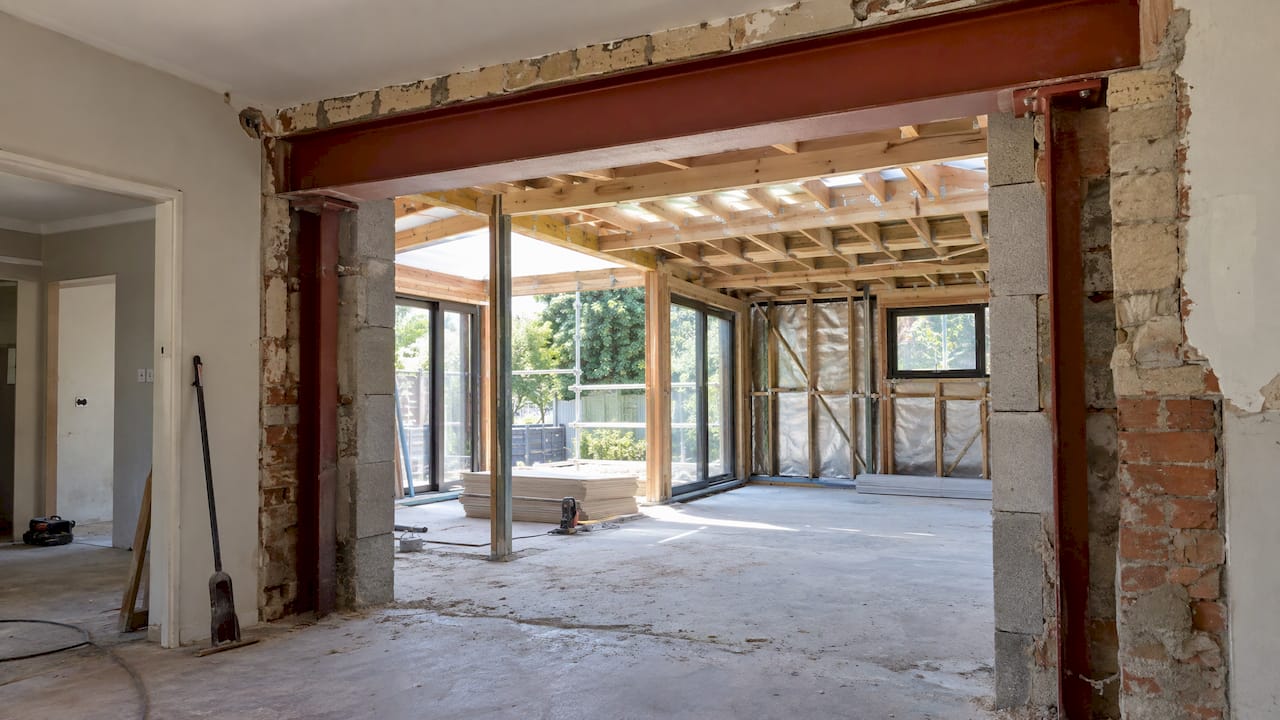
Westpac treats renovations costing $250,000 or less as standard or cosmetic in its guide. Above that, a construction loan with a fixed-price contract and staged drawdowns may be used. Each lender sets its own thresholds, so treat $250,000 as one example rather than a universal line.
Which option fits which project
| Project | Typical funding route | Why it fits |
|---|---|---|
| Bathroom, kitchen or laundry update | Offset or redraw funds, mortgage top-up, or personal loan | Single contained job, no structural work, often within personal loan limits |
| Whole-home cosmetic renovation | Mortgage top-up or refinance | Larger sum, long repayment term, lower rate than unsecured credit |
| Extension, second storey or granny flat | Construction loan | Staged payments follow the building stages |
| Knock-down rebuild or duplex | Construction loan | Needs plans, permits and a building contract before the lender releases funds |
If you are weighing a bathroom, our bathroom renovation cost guide shows how to size the budget before you choose a funding route. For larger additions, our home addition planning guide explains the approvals that sit behind a construction loan.
How much you can borrow and what lenders check
Your borrowing capacity comes down to two things: the value of your property and your ability to repay.
Property value. Westpac says total borrowing, including your existing loan, may reach up to 90% of the property’s value, and borrowing above 80% of value may require Lenders Mortgage Insurance (a one-off premium that protects the lender, not you). A worked example: if your home is valued at $1,200,000 and 80% is $960,000, a mortgage balance of $700,000 leaves $260,000 of room before that 80% mark. Your lender’s own valuation decides the real figure, and a valuation that allows for the improved home is not something you should assume.
Repayment capacity. For renovations under $250,000, Westpac says it assesses living expenses, financial position and evidence of income. Lenders must do this by law: ASIC states that credit licensees must make reasonable inquiries about your circumstances and take reasonable steps to verify your financial situation. Banks also test whether you could still repay if rates rose. APRA says the mortgage serviceability buffer remains at 3 percentage points, which is a cushion against unforeseen changes in a borrower’s circumstances.
In plain terms, a lender will not look at the dream bathroom or extension. It will look at your payslips, your spending and your existing debts, and then test them against a higher interest rate than you will actually pay.
Costs and risks to check before you sign
A low headline rate can hide a poor deal. Moneysmart’s home loan guidance suggests comparing:
- the interest rate and the personalised comparison rate
- the total amount you will repay and the monthly repayment
- establishment and ongoing fees
- charges for extra repayments, offset or redraw use, and break costs, some of which a Key Facts Sheet may not capture
Offset is not automatically a win either. Moneysmart says an offset account may not be worthwhile where the balance is low or where fees or a higher rate outweigh the benefit.
The risk that catches most renovators is the overrun. NAB’s building and renovating guide states that costs above the approved funds are the borrower’s responsibility, and progress payments may stop until the overrun is covered. A project with a clear scope, itemised pricing and a contingency allowance protects you from that situation. Before you set the loan amount, price every element of the job, including finishes you might upgrade later. If part of your plan involves stone benchtops, an estimate of countertop costs shows the kind of line items worth pricing up front.
How to apply, step by step
- Define the scope. Decide what is in and what is out: bathroom only, or bathroom plus laundry? Structural work or cosmetic? A tight scope gives a tight number.
- Get a detailed written quote. Lenders and builders both work from numbers on paper. If you are in Sydney, you can request a quote from our team to put a figure on your project.
- Add a contingency. Build in a buffer for the unexpected, because overruns are yours to pay.
- Check your borrowing capacity. Look at your equity, your existing loan type (fixed or variable) and what repayment you can sustain.
- Compare products. Use the checklist above, and consider speaking with a mortgage broker or your lender’s home loan specialist, who are the right people to advise on your finances.
- Gather documents. NAB may ask for income, monthly expenses, assets, liabilities and supporting documents. For construction funding it may also require a signed fixed-price contract, plans, specifications, permits and builder insurance.
- Draw funds as work progresses. For a construction loan, each progress payment needs a signed certificate and relevant claims, invoices or receipts, according to NAB’s guide.
Starting with the quote matters because every later step relies on it. You cannot honestly size a loan, test your repayments or satisfy a lender’s paperwork without a defined build cost.
Renovating an investment property
If the property is a rental, the same funding routes apply, but the questions change: what will the work add to rent and value, and how will the expense be treated at tax time? Our guide to rental property renovation upgrades and returns covers what to upgrade first. Because tax treatment of repairs and improvements depends on your circumstances, confirm how the loan interest and the works will be handled with your accountant before you commit.
Our view: scope first, loan second
We see the loan conversation go best when the project is fully defined before anyone talks about borrowing. A homeowner who comes to a lender with a clear scope, a written quote and a realistic contingency can choose the right product, not simply the one that is available.
Our work covers demolition, carpentry, structural alterations, plumbing, electrical work, waterproofing, tiling, cabinetry and complete renovation project management. Having those trades under one project means the quote you take to your lender reflects the whole job, not one piece of it.
We also stand behind the finished work with a 7-year workmanship warranty. For a family putting a significant sum into their home, that is the kind of long-term assurance that should sit alongside the finance.
Start with the building plan, then match the funding to it.
McArthur
Plan your renovation with McArthur
We are a licensed Sydney builder working across the Eastern Suburbs, Lower and Upper North Shore, Northern Beaches and Hills District, including Mosman, Vaucluse, Double Bay, Pymble and Wahroonga. Whether you are planning a bathroom, a kitchen, a whole-home renovation or a home extension, we can give you the scope and written figures that your lender will ask for.

For general planning help, see our renovation advice page, or request a quote when you are ready.
FAQ
Can I borrow money to renovate my house?
Yes. Australians commonly use a mortgage top-up, offset or redraw funds, a personal loan or a construction loan. Which one suits depends on the project size, your equity and whether the work is structural.
How much can I borrow for a home improvement loan?
It depends on the loan type and your finances. For a mortgage-based loan, one major bank says total borrowing including your existing loan may reach up to 90% of the property’s value, with Lenders Mortgage Insurance possibly required above 80%. Personal loans are smaller: ANZ’s renovation loan, for example, allows requests of $5,000 to $75,000, subject to approval.
Is a construction loan needed for a renovation?
It is usually considered for structural work, extensions and major projects that need council approval or a building permit. Funds are paid in stages as the building progresses. Smaller cosmetic renovations are often funded another way.
What documents will a lender want?
Expect to show income, monthly expenses, assets and liabilities. For construction funding, a lender may also ask for a signed fixed-price contract, plans, specifications, permits and builder insurance.
Sources
- Home Renovation Loans in Australia, Canstar
- Mortgage offset accounts, Moneysmart
- Pay off your mortgage faster, Moneysmart
- Choosing a home loan, Moneysmart
- Renovation lending, NAB
- Your guide to building and renovating, NAB
- A personal loan for home renovations, ANZ
- Using equity to renovate your home, Westpac
- Update on Macroprudential Settings, APRA
- Report REP 410, ASIC
- Countertop estimate guide, Stone Proz

One Response