
A luxury bathroom renovation is won or lost before the first tile is laid. The calm, spa-like result comes from proportions, light, layout and a waterproofing system that passes inspection, and then from finishes. For Sydney homeowners the safest way to get all of that is one licensed builder who manages design coordination, plumbing, electrical, waterproofing, tiling and cabinetry as a single project. That is how we run bathroom renovations at McArthur, backed by a 7-year workmanship warranty.
This guide covers what makes a bathroom feel high-end, what moves the price, the rules that apply in NSW, the mistakes that cost homeowners most, and how to judge whether the spend adds value to your home.
TL;DR
- Luxury is about space, natural light, touchable materials and calm. Layout decisions matter more than the price of any single fitting.
- Moving plumbing, adding a hobless shower, custom joinery, natural stone and heating are the biggest cost drivers, so settle the layout and fixture list before work begins.
- Waterproofing is the most common defect category in Australian building, and the 2022 National Construction Code (NCC) tightened wet-area rules from 1 May 2023.
- Most changes that keep walls and structure as they are can be exempt development in NSW, but heritage and mapped land can change that.
- One builder managing every trade, with a workmanship warranty, keeps a high-end project on programme and accountable.
Table of Contents
- What actually makes a bathroom feel luxurious
- Start with the layout
- Where the budget goes
- Waterproofing: the part you never see and can least afford to get wrong
- Approvals in NSW
- Mistakes that turn a luxury bathroom into a regret
- Will it add value?
- How the project runs
- Our view on luxury bathrooms
- Planning a luxury bathroom in Sydney
- FAQ
- Sources
What actually makes a bathroom feel luxurious
Open any glossy feature and the pattern is the same: generous natural light, materials you want to touch, space that breathes and a sense of calm. An architect’s guide to luxury bathroom design argues that this feeling comes from design decisions such as proportions, the window and the connection to the bedroom, not from simply adding more products.
That is useful because it tells you where to put your money. A mid-priced fitting in a well-proportioned room with a good window beats an expensive one squeezed into a cramped plan.
Practical indulgences
Designers quoted by Home Beautiful describe “practical indulgences”: heated towel rails, underfloor heating, task lighting, concealed storage and wall hooks placed exactly where you reach for them. They also report a move towards quiet luxury, with natural materials paired with clean porcelain or ceramic and marble used as a softer accent rather than covering every surface.
For a family bathroom, this is the sweet spot. You get a room that feels special every morning and still wipes clean in a minute.
The features high-end briefs usually include
- A freestanding bath or a generous walk-in shower as the centrepiece
- A double vanity with soft-close drawers and stone or solid-surface tops
- A wall-hung toilet with an in-wall cistern, which frees floor space and is easy to clean around
- Large-format porcelain tiles with fewer grout lines
- Frameless glass screens
- Layered lighting and a mirror with integrated light
- Heating underfoot and on the towel rail
Not every item belongs in every bathroom. A good builder will tell you which ones your room can carry. A freestanding stone-resin bath, for example, is heavy, and on an upper floor it needs a structural check before it is ordered.
Start with the layout
Home Beautiful’s layout guide, quoting a designer, explains the two basic plans. An “all on a wall” arrangement suits smaller bathrooms, while a wet-and-dry split suits bigger ones: the shower or bath is separated by glass or a partial wall from the vanity and toilet. The same guide advises working with existing plumbing where you can, because moving it is costly.
That last point is the single most useful budget lever. If your drains and supply lines stay where they are, more of the budget goes into what you see and touch. If the room genuinely needs a new plan, for example to fit a bath and a double vanity, it is money well spent, but it should be decided at the design stage and not discovered halfway through.
Settle everything before demolition
Domain’s advice on bathroom renovation errors puts changing the layout mid-build at the top: decide every fixture before you start. Waste positions for the bath, vanity and shower are set at rough-in, which is the stage where pipes are installed before walls are closed. Changing them after tiling begins means breaking up finished work.
A practical order of decisions:
- Room plan and fixture positions
- Major fixtures, such as bath, vanity and shower system, so their plumbing requirements are known
- Tiles, laid out against the plan
- Tapware, accessories, mirror and lighting
- Colour and finish palette, checked as one scheme
On a project of ours the same logic applies: the plumber, electrician, waterproofer, tiler and cabinetmaker all work from the same confirmed plan, because we coordinate those trades ourselves as part of complete renovation project management.
Where the budget goes
Luxury bathrooms in Australia are priced from the tens of thousands upward, and the spread is wide because the variables are wide. Rather than quote a headline number that depends on your room, it helps to know the drivers. Our own bathroom renovation cost guide goes through them in detail.
| Cost driver | Why it moves the price |
|---|---|
| Room size | More floor, wall and waterproofing area, more tile and labour |
| Layout changes | Relocating the bath, shower, vanity or toilet means new plumbing and often electrical work |
| Tile choice and size | Natural stone and large-format slabs cost more to buy and to lay |
| Custom joinery | Made-to-fit vanities and storage are priced by the metre and finish |
| Shower type | A hobless (no-step) shower needs more careful falls and waterproofing |
| Heating and technology | Underfloor heating, heated rails and smart toilets add electrical work |
| Hidden conditions | Old walls and floors can reveal defects once demolition starts |
Keep a contingency
Home Beautiful’s regrets piece, quoting a bathroom company director, recommends a 15 to 20 per cent contingency for structural and plumbing surprises behind old walls, including asbestos removal and re-routing old pipes. In older Sydney homes, particularly in the Eastern Suburbs and Lower North Shore, that buffer is sensible.
A worked example: on a $60,000 budget, hold back between $9,000 and $12,000. If nothing surprising turns up, it becomes your upgrade fund for the last decisions, such as heating or better tapware.
Choose a package or a custom scope
If you want a defined starting point, we offer Standard, Premium and Diamond bathroom renovation packages. For a fully bespoke brief, the bathroom renovations service is scoped around your room and your finish selections.
Waterproofing: the part you never see and can least afford to get wrong
Choice reports that, according to the Master Builders Association of NSW, waterproofing tops the list of building defects in every Australian state and territory. The membrane under your tiles is what keeps water out of the frame, the ceiling below and the neighbour’s wall. Luxury features such as hobless showers, niches and floor-to-ceiling stone put more demand on it, not less.
What the NCC 2022 changed
The Housing Industry Association’s wet-area guide says the NCC 2022 waterproofing changes commenced on 1 May 2023. Among them:
- Shower walls must be waterproofed to at least 1,800 mm above the shower floor, and for unenclosed showers the waterproofing extends 1,500 mm from the shower rose.
- Floor falls, the slope that sends water to the drain, must be between 1:80 and 1:50.
- A toilet with a hand-held bidet spray is treated more like a shower enclosure.
- Polished concrete can be used as a shower substrate without a Performance Solution.
The official NCC 2022 wet-area provisions also state that wet-area elements must comply with AS 3740, the waterproofing standard, and that baths and spas other than freestanding ones need an upturn lip and must be recessed into the wall, with the water-resistant substrate passing down inside the lip.
The HIA guide adds that the NCC nominates which areas must be waterproofed and how far, while AS 3740 covers how the membrane, drainage penetrations, junctions and step-downs are installed. The two documents are read together.
What this means for your project
You do not need to memorise clause numbers. You need a builder who treats waterproofing as a scheduled, inspected stage: membrane applied, cured, inspected, and only then tiled. Large-format floor-to-ceiling tiling needs that time built into the programme. Waterproofing, tiling, plumbing and electrical work are all part of our in-house service list, so the sequence is planned by one team rather than negotiated between separate contractors.
Approvals in NSW
Many homeowners assume a high-end bathroom needs council approval. Often it does not. The HIA explains that, under the Codes SEPP, renovating a bathroom or kitchen can be exempt development if the relevant development standards are met. That means no council or certifier approval, though the work must still meet the Building Code of Australia.
Things that can take you outside that pathway include structural changes, heritage-listed homes and land affected by mapped exclusions. In heritage-sensitive streets around Vaucluse or Mosman, confirm the status of your property before design is locked in. Our guide to bathroom renovations in Mosman covers planning, approvals and costs for that area.
Mistakes that turn a luxury bathroom into a regret
The advice from designers and architects is consistent. These are the ones that come up most.
Harsh single-source lighting
Domain’s piece quotes an architect warning that one overhead light creates unflattering shadows. The fix is layered lighting: ambient, task and accent. Plan the circuits early, because that is electrical work that must be done before walls close.
Surfaces that are hard to clean
Tiny tiles, awkward gaps behind baths and above-bench basins all collect grime. The same Domain article also advises keeping natural timber away from basins, baths and showers and choosing moisture-resistant materials such as porcelain or engineered stone near water.
Too many finishes
Home Beautiful’s regrets article recommends the 60-30-10 rule: roughly 60 per cent of the room in a dominant finish, 30 per cent in a secondary material and 10 per cent in accents. It also suggests matching the basin, shower and bath spouts in one metal finish. Individually beautiful pieces rarely work together unless something organises them.
Not planning the wet zone
The same article quotes a designer suggesting a dedicated wet zone with generous splash distance and a ceiling-mounted rain head to cut lateral spray. In a luxury bathroom with timber or stone floors outside the shower, this detail protects the finishes you paid for.
Ordering before the plan is final
Buying a freestanding bath or a double vanity before the room plan is confirmed is how a fixture ends up not fitting its waste position, wall or door swing. Confirm the plan, then order.
Will it add value?
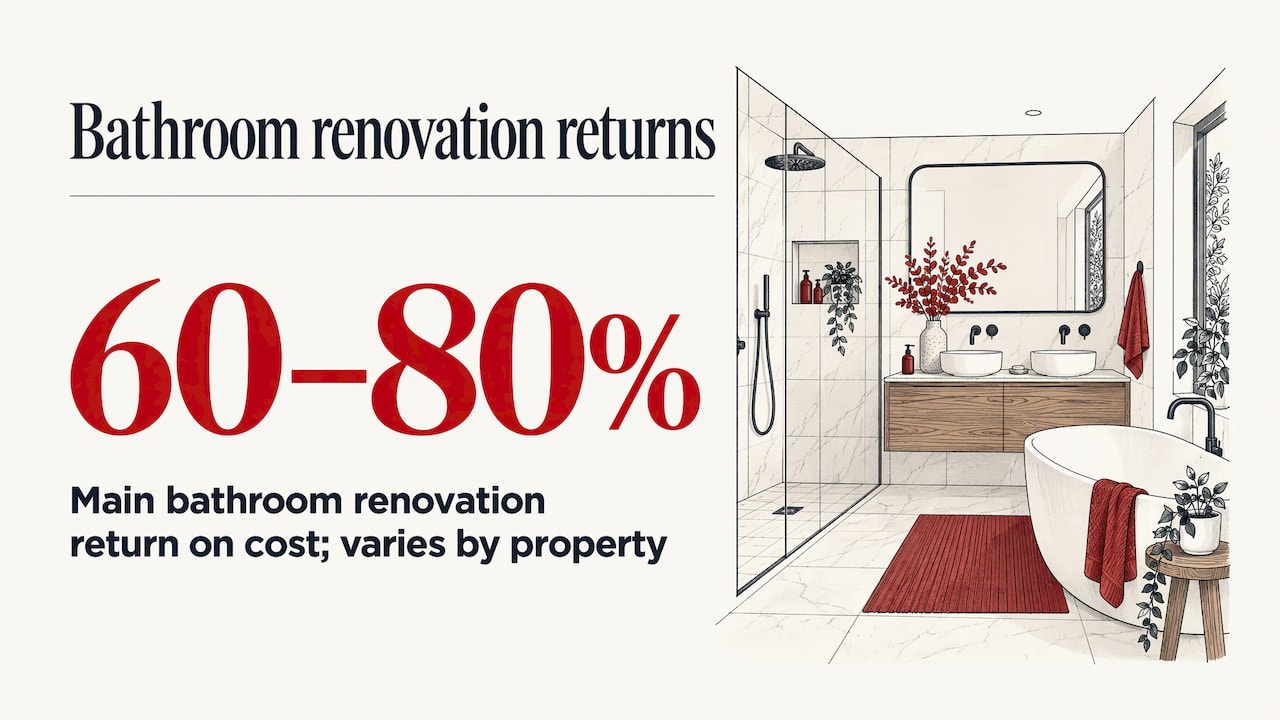
For property investors and owners planning to sell, the answer depends on the property. Smart Property Investment reported an analysis putting a main bathroom renovation at a 60 to 80 per cent return on cost, with returns varying by location, quality of the work, the property’s value and the type of home in highest local demand. The same piece suggested a one-colour scheme, tiled walls and, where space allows, two basins with a separate shower and bath to help buyers picture themselves in the room.
In practice, that means matching the finish level to the street. In suburbs such as Double Bay, Bellevue Hill or Mosman, buyers expect premium finishes. For a rental, a different scope usually makes sense, and our rental property renovation guide sets out what to upgrade and what it returns.
How the project runs
A luxury bathroom involves a plumber, a builder, a tiler, a waterproofer and often an electrician and a cabinetmaker. Industry guides note that an extensive remodel can run anywhere from a few weeks to several months, depending on scope and how much is custom-made. Long-lead items such as stone, custom joinery and imported fittings are the usual cause of delay, so order them once the plan is confirmed.
A sensible sequence on site:
- Demolition and strip-out
- Inspection of the frame, floor and walls, and any repairs
- Plumbing and electrical rough-in
- Waterproofing, curing and inspection
- Tiling and joinery installation
- Fit-off of fixtures, glass, mirrors and lighting
- Final clean, walk-through and handover
Having one team coordinate these stages is the practical benefit of a builder-led project. It also means one party stands behind the finished work, and ours carries a 7-year workmanship warranty.
Our view on luxury bathrooms
We build bathrooms for people who will use them every day, so we start with how the room should work and feel before we talk about finishes.
The luxury that lasts is in the details you stop noticing: a floor that falls properly to the drain, tiles set to a clean layout, joinery made to fit the room, and a shower that does not leak. Those things come from careful project management and good trades working to one plan.
That is why we handle demolition, carpentry, plumbing, electrical work, waterproofing, tiling and cabinetry as part of one renovation, and why we stand behind our workmanship for seven years. A premium bathroom should look good on handover day and still look good long after.
McArthur
Planning a luxury bathroom in Sydney
We renovate bathrooms across the Eastern Suburbs, Lower and Upper North Shore, Northern Beaches and the Hills District, from premium finishes through to fully bespoke designs. If you are weighing a Standard, Premium or Diamond scope, the bathroom renovation packages page shows the options, or you can request a bathroom renovation quote and we will talk through your room, your layout and your budget.
If the bathroom is part of a bigger plan, our home renovations service covers luxury renovations across the whole house.
FAQ
How do I make my bathroom feel luxurious?
Focus on light, space and calm before products. Use a simple palette of two or three materials, layer your lighting, and add practical touches such as underfloor heating, a heated towel rail and concealed storage. A freestanding bath or a spacious walk-in shower works as a centrepiece if the room can carry it.
What drives the cost of a high-end bathroom renovation?
The biggest factors are room size, whether plumbing is relocated, the type and size of tile, custom joinery, the shower style and any heating or technology. Hidden conditions behind old walls can add to the bill, so hold a 15 to 20 per cent contingency. Our bathroom renovation cost guide explains each driver.
Do I need council approval for a bathroom renovation in NSW?
Often not. Renovating a bathroom can be exempt development under the Codes SEPP when the development standards are met, and the work must still comply with the Building Code of Australia. Structural changes, heritage items and mapped land can change the answer, so check your property before you design.
What are the most common luxury bathroom mistakes?
Changing the layout mid-build, relying on a single overhead light, choosing tiny tiles or details that trap dirt, mixing too many finishes and rushing waterproofing. Fixing the plan and fixture list before demolition avoids most of them.
Does a luxury bathroom add value to my home?
It can. A published analysis puts main bathroom returns at 60 to 80 per cent of cost, varying with location and the quality of the work. Matching finishes to what buyers in your suburb expect is what protects the return.
Sources
- Luxury Bathroom Design: An Architect’s Guide
- Interior designers predict the biggest bathroom trends
- Bathroom design layout ideas, Home Beautiful
- What to avoid when renovating a bathroom, Domain
- Bathroom Renovation Regrets, Home Beautiful
- 5 bathroom renovation rip-offs and how to avoid them, Choice
- HIA Guide to Wet Area Waterproofing
- NCC 2022 Part 10.2 Wet area waterproofing
- HIA: Are bathroom and kitchen renovations exempt development
- Which renovations deliver the best returns?, Smart Property Investment